+33 (0)4 72 14 17 99
0 Quote
Contact us

Introduction

In an industrial IT project, choosing a processor is not simply a matter of selecting the most powerful CPU.

An industrial PC, a Panel PC or an edge gateway is subject to different constraints than an office computer. It must operate reliably, sometimes 24 hours a day, 7 days a week, in environments exposed to heat, vibrations, dust, power fluctuations or mechanical integration constraints.

This is why the choice of a CPU platform must be guided by the actual application, the installation environment and the system’s lifespan requirements.

Why is the choice of CPU so crucial in an industrial environment?

In industry, a processor that is too weak can limit an application’s performance. However, a processor that is too powerful can also pose problems: greater heat generation, high power consumption, the need for cooling, a larger footprint or more complex integration.

The right industrial CPU is therefore one that offers the best balance between computing power, heat dissipation, power consumption, software stability, expandability and long-term availability.

The main criteria to consider are:

  • The actual computing power required;
  • The system’s thermal behaviour;
  • Power consumption;
  • the need for fanless operation;
  • the available interfaces;
  • Expansion options for PCIe, LAN, COM, USB or GPU;
  • Software compatibility;
  • The long-term availability of the platform;
  • The risks associated with obsolescence.

In many cases, the latest or highest-performance platform is not necessarily the most suitable. A more mature platform, which is better understood and easier to cool, can offer greater stability over several years.

The main families of CPU platforms used in industrial PCs

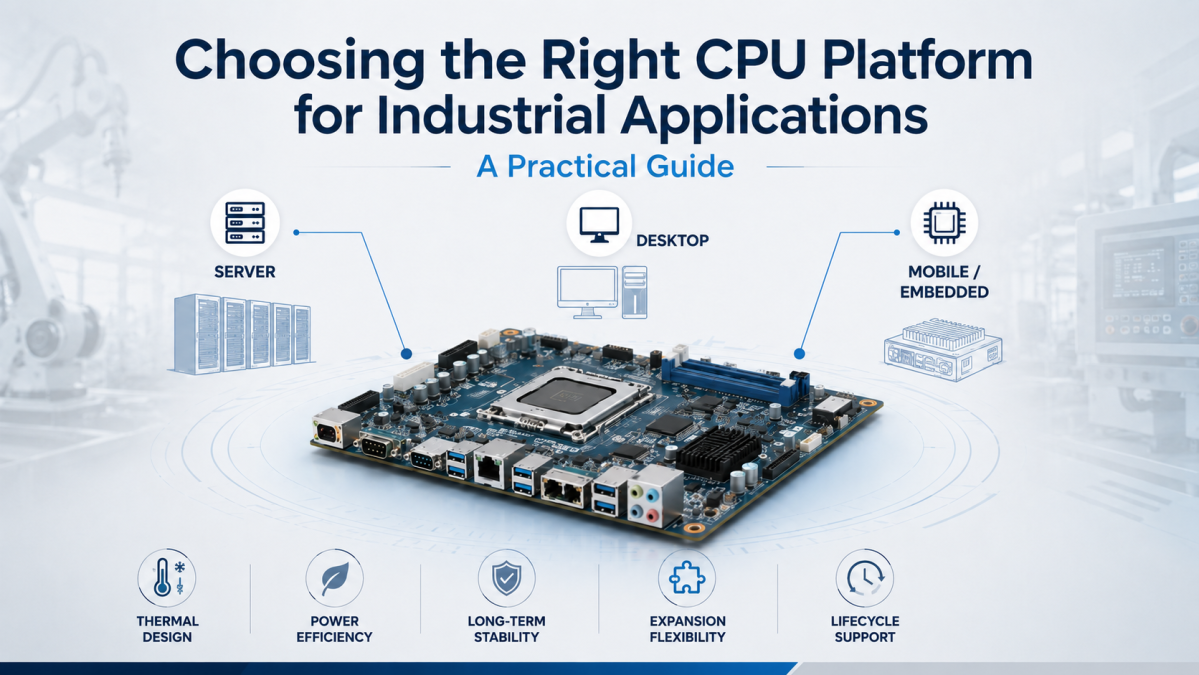
Industrial IPC projects generally rely on three main categories of platforms: server platforms, desktop platforms and mobile or embedded platforms.

Each family meets different needs.

1. Server platforms: power, intensive computing and scalability

Server platforms are used when the application requires significant processing power or high scalability.

They are generally based on Intel Xeon or Xeon D processors.

Typical applications

Server platforms are particularly well-suited to the following applications:

  • Adge AI;
  • AI inference;
  • Advanced machine vision;
  • Multi-camera processing servers;
  • Virtualisation;
  • Data acquisition and aggregation;
  • Intensive processing at the network edge.

These platforms are often used when multiple video streams, AI accelerators, acquisition cards or GPU cards need to operate within the same system.

Advantages

The main advantages of server platforms are:

  • High multi-core performance;
  • Potential support for ECC memory depending on the platform;
  • High PCIe bandwidth;
  • High scalability;
  • Compatibility with GPU cards or AI accelerators;
  • Good ability to handle multiple simultaneous processes.

Points to note

However, these platforms require particular attention during the integration phase.

They often involve:

  • Higher power consumption;
  • Significant heat generation;
  • A bulkier housing;
  • Enhanced thermal management;
  • And, in some cases, active cooling.

In an industrial environment, raw performance is not enough. Heat dissipation, ventilation, dust, maintenance and space requirements must be taken into account from the outset.

A server platform is appropriate when computing requirements genuinely justify this level of complexity.

2. Desktop platforms: performance, versatility and expandability

Desktop platforms remain widely used in industrial PCs, particularly where a combination of computing power, extensive connectivity and expandability is required.

They are generally based on Intel Core, Intel Celeron or Intel Pentium processors, depending on the required level of performance.

65 W desktop platforms: for demanding applications

Standard desktop processors, such as the Intel Core i5, i7 or i9, are often chosen for industrial applications requiring high processing power.

Examples of commonly used processors:

  • Intel Core i5-12500;
  • Intel Core i7-12700;
  • Intel Core i9-12900.

Typical applications

These platforms are suitable for the following uses:

  • Machine vision;
  • AOI;
  • Camera-based quality control;
  • Multi-camera processing;
  • Industrial analysis;
  • Data acquisition and processing;
  • Applications requiring high single-threaded performance.

Advantages

They generally offer:

  • Very good computational performance;
  • Excellent single-threaded performance;
  • Great flexibility in integration;
  • Significant expansion capabilities;
  • Compatibility with a wide range of industrial boards.

Limitations

The main consideration is cooling.

A standard desktop processor may be more difficult to integrate into a compact, fanless system. Heat dissipation may require a larger enclosure, a suitable heat sink, or even forced cooling, depending on the configuration.

These platforms are therefore the preferred choice when performance is the priority and thermal constraints are well managed.

3. Low-power desktop platforms: the balance between performance and thermal management

Low-power desktop processors often offer a very good compromise for fanless industrial PCs, industrial gateways and automation systems.

Examples of typical processors:

  • Intel Core i5-12500T;
  • Intel Core i7-12700TE.

Typical applications

These platforms are used in:

  • Industrial fanless PCs;
  • Automation systems;
  • Industrial gateways;
  • Supervision workstations;
  • SCADA applications;
  • Industrial terminals;
  • Edge applications requiring a good balance between performance and power consumption.

Why is this choice often a good one?

Compared to a standard desktop platform, a low-power version often offers a better balance between:

  • Performance;
  • Thermal behaviour;
  • Power consumption;
  • Compactness;
  • Stability during continuous operation;
  • Integration into a fanless enclosure.

For many industrial applications, this balance is more important than maximising performance.

A slightly less powerful processor that is easier to cool can enable the design of a more stable, quieter system that is better suited to long-term operation.

4. Entry-level platforms: simplicity, controlled costs and stability

Platforms based on Intel Celeron or Intel Pentium remain very common in simple industrial applications.

They are not chosen for their high performance, but for their efficiency, controlled costs and maturity.

Typical applications

These platforms are used in:

  • Simple control systems;
  • HMI terminals;
  • Lightweight SCADA workstations;
  • Data acquisition;
  • Basic monitoring;
  • Cost-sensitive projects;
  • Applications not requiring heavy processing.

Advantages

Their appeal lies in several factors:

  • Reduced power consumption;
  • More affordable cost;
  • Proven ecosystem;
  • Easier integration;
  • Limited heat dissipation;
  • Sufficient stability for many industrial tasks.

In many projects, an entry-level processor is perfectly suited. There is no need to overspecify a platform if the application simply involves displaying an interface, collecting data or communicating with industrial equipment.

5. Mobile and embedded platforms: compact, low-power and fanless

Mobile and embedded platforms are playing an increasingly important role in industrial computing.

They are particularly well-suited to compact systems, Panel PCs, edge gateways, embedded devices and fanless industrial PCs.

They are based in particular on:

  • Intel Core U Series;
  • Intel Core P Series;
  • Intel Core H Series;
  • Intel Core Ultra;
  • Intel N-series processors;
  • Intel Atom;
  • Long-life embedded platforms.

Mobile Intel Core processors

Examples of typical processors:

  • Intel Core i5-1235U;
  • Intel Core i7-1355U;
  • Intel Core Ultra 5 125U.

Typical applications

These platforms are suitable for the following applications:

  • Compact IPC;
  • Industrial panel PC;
  • Edge gateway;
  • Embedded system;
  • Industrial terminal;
  • Transport;
  • Equipment installed in confined spaces.

Advantages

Their main benefit is their performance-to-power consumption ratio.

They enable the design of systems that are:

  • More compact;
  • More energy-efficient;
  • Easier to cool;
  • Compatible with fanless designs;
  • Suitable for continuous operation.

These platforms are particularly suitable when space is limited or when eliminating fans is a key requirement.

6. Intel N-series Processors: efficiency and low heat dissipation

Intel N-series processors, such as the N97, N100 and N305, are gradually replacing certain older Atom or J-series platforms in light industrial applications.

Typical applications

They are used in:

  • HMI terminals;
  • Compact Panel PCs;
  • Data acquisition;
  • Logistics terminals;
  • AGVs;
  • Light industrial gateways;
  • Simple display or monitoring systems.

Why choose them?

Their main advantage is energy efficiency.

They offer:

  • Very low power consumption;
  • Limited heat generation;
  • Easy integration into compact enclosures;
  • Good compatibility with fanless systems;
  • Sufficient performance for many common industrial applications.

For an HMI terminal, a gateway or a small data acquisition system, raw power is not always the priority. Stability, low power consumption and thermal simplicity can be far more important.

7. Legacy embedded platforms: stability and continuity

Some older platforms are still widely used in industry.

Examples of typical processors:

  • Intel Celeron J6412;
  • Intel Atom x6413E;
  • Intel Celeron J1900.

Although newer generations are available, these platforms remain of interest in many industrial projects.

Why are they still in use?

In industry, stability is often more important than the latest technology.

A mature platform can offer:

  • Well-understood thermal behaviour;
  • Stable drivers;
  • Software compatibility that has already been validated;
  • Greater continuity for existing installations;
  • A reduced risk of redesign;
  • A controlled lifecycle.

For equipment that needs to operate for several years without major modifications, a tried-and-tested platform can offer greater peace of mind than a newer processor that has not been fully validated in the target environment.
How do you choose the right CPU for an industrial application?

CPU selection should start from real field requirements, not only from a performance datasheet.

Here are a few common use cases.

Case 1: Small fanless system or industrial Panel PC

Typical applications

  • Panel PC;
  • MES terminal;
  • production HMI;
  • logistics terminal;
  • AGV controller;
  • compact gateway.

Commonly suitable platforms

  • Intel Core i5-1235U;
  • Intel N97;
  • Intel Celeron J6412.

Key priorities

  • Fanless operation;
  • Low heat generation;
  • Compact footprint;
  • Reduced power consumption;
  • Stability in continuous operation;
  • Compatibility with the software environment.

For this type of project, it is important to avoid oversizing the CPU when the application does not require it. A power-efficient, well-integrated processor can be more relevant than a more powerful platform that generates more heat.

Case 2: Machine vision and multi-camera processing

Typical applications

  • AOI;
  • Quality inspection;
  • Machine vision;
  • Image processing;
  • AI gateway;
  • Video analytics;
  • Camera-guided robotics.

Commonly suitable platforms

  • Intel Core i5;
  • Intel Core i7;
  • Intel Xeon;
  • platforms with GPU expansion depending on the project requirements.

Key priorities

  • Computing power;
  • PCIe bandwidth;
  • Camera connectivity;
  • GPU expansion or AI accelerator support;
  • Fast storage;
  • Real-time processing;
  • Thermal stability.

In machine vision applications, the CPU should not be assessed on its own. Acquisition cards, camera interfaces, GPU, storage and the overall thermal dissipation of the system must also be taken into account.

Case 3: Industrial control, SCADA and data acquisition

Typical applications

  • Industrial automation;
  • SCADA;
  • HMI;
  • Data acquisition;
  • Machine communication;
  • Light supervision.

Commonly suitable platforms

  • Intel Celeron J6412;
  • Intel N97;
  • Intel Celeron J1900;
  • Intel Atom, depending on project constraints.

Key priorities

  • Stability;
  • Low power consumption;
  • Long-term availability;
  • OS compatibility;
  • Industrial connectivity;
  • Controlled cost.

For this type of project, CPU power is rarely the main decision factor. The priority is often stability, compatibility with existing equipment and continuity of operation.

Case 4: Edge computing and industrial artificial intelligence

Typical applications

  • Edge AI;
  • AI inference;
  • Field data analysis;
  • Predictive maintenance;
  • Intelligent inspection;
  • Local processing of industrial data.

Commonly suitable platforms

  • Intel Core i7;
  • Intel Core i9;
  • Intel Xeon;
  • Platforms compatible with GPU or AI accelerators.

Key priorities

  • Multi-core performance;
  • GPU capability;
  • PCIe bandwidth;
  • Available memory;
  • Fast storage;
  • Network connectivity;
  • Appropriate cooling.

Industrial edge computing requires data to be processed as close as possible to the equipment. CPU selection must therefore be aligned with the data volume, processing frequency, AI models used and installation constraints.

Selection table: which CPU platform for which requirement?

Industrial need Recommended CPU platform Why?
Simple HMI or operator terminal Intel N-series, Celeron, Atom Low power consumption, controlled cost, easy integration
Fanless Panel PC Intel Core U-series, N97, J6412 Good balance between performance and thermal behavior
Industrial gateway Intel N-series, Core U, Celeron Compact design, connectivity, continuous operation
SCADA or data acquisition Celeron, Atom, N-series Stability, compatibility, low power consumption
Machine vision Intel Core i5/i7, Xeon Computing power, PCIe expansion, image processing
Multi-camera / AOI Core i7, Core i9, Xeon High performance, bandwidth, possible GPU integration
Edge AI Core i7/i9, Xeon, GPU-enabled platform Intensive computing, AI acceleration, local processing
Cost-sensitive project Celeron, Pentium, N-series Controlled price, sufficient performance
Long lifecycle project Proven embedded platform Stability, validated drivers, reduced redesign risk

Common mistakes when choosing an industrial CPU

Choosing the most powerful processor

This is the most common mistake.

A powerful processor may seem reassuring, but it can generate more heat, consume more power and complicate integration. In a fanless enclosure or a confined space, this can become a real problem.

Neglecting thermal behaviour

In an industrial environment, thermal management is just as important as performance.

An unsuitable CPU can lead to performance drops, premature wear or system instability.

Overlooking the product lifecycle
An industrial PC is often deployed for several years. It is therefore essential to consider the platform’s availability, software compatibility and the risks of obsolescence.

Overspecifying a simple application

Not all applications require an Intel Core i7 or a Xeon.

For an HMI, a lightweight monitoring system or data acquisition, a more modest platform may offer a better overall balance.

Treating the CPU in isolation from the rest of the system

The CPU is just one component of the configuration. It must be selected alongside memory, storage, interfaces, power supply, the chassis, cooling and communication options.

Choosing the right CPU always depends on the situation

There is no single ‘best’ universal CPU platform for industrial computing.

The right choice depends on several factors:

  • The software application;
  • The expected level of performance;
  • The ambient temperature;
  • The need for a fanless design;
  • The available space;
  • The required interfaces;
  • Network constraints;
  • The expected service life;
  • The budget;
  • Maintenance requirements.

In industry, the right platform is one that meets the actual requirements without unnecessarily complicating the system.

A less powerful but appropriately sized CPU can result in a system that is more stable, more durable and easier to maintain.

The INtronix Systems approach

The choice of a CPU platform always begins with an analysis of the application.

Our aim is not to offer the most powerful processor, but the configuration that best meets your operational requirements: performance, thermal management, connectivity, mechanical integration, availability, cost and service life.

Our industrial platforms cover a wide range of configurations: Intel Core i3, i5, i7, i9, Celeron, Pentium, Atom, ARM, as well as fanless solutions, Panel PCs, Box PCs, embedded PCs and customisable systems.

Depending on the project, we can tailor the CPU, RAM, storage, I/O, connectivity, power supply, mounting or chassis to provide a solution that is truly suited to your industrial environment.

Need help choosing the right CPU platform?

Are you unsure whether to choose an Intel Core, Celeron, Atom, N-series or Xeon platform for your industrial project?

Our teams will help you select the industrial PC, Panel PC or fanless system best suited to your application.

Contact us now to design a robust, sustainable solution that meets your integration requirements.

FAQ – How do you choose an industrial processor?

What is the best processor for an industrial PC?

There is no single ‘best’ all-purpose processor. The choice depends on the application, the required level of performance, heat dissipation, the necessary interfaces and the project’s lifespan.

Should you choose an Intel Core i7 for an industrial PC?

Not always. An Intel Core i7 is suitable for machine vision, multi-camera processing or edge computing. For an HMI, a gateway or a lightweight monitoring system, a Celeron, Atom or N-series platform may be sufficient.

Which CPU should you choose for a fanless industrial PC?

For a fanless system, you should opt for a low-power processor with low heat output, such as certain Intel Core U-series, Intel N-series or Celeron embedded platforms.

Why are some older processors still in use in industry?

Because they are stable, well-established, compatible with existing environments and often available over longer cycles. In industry, continuity can be more important than innovation.

Which processor should you choose for machine vision?

Machine vision applications often require Intel Core i5/i7, Intel Core i9 or Xeon platforms, depending on the number of cameras, image processing requirements, GPU needs and PCIe bandwidth.