+33 (0)4 72 14 17 99
0 Quote
Contact us

Artificial intelligence is becoming increasingly important in industrial applications, including machine vision, automated inspection, object recognition, OCR, robotics and data analysis.

But before selecting a GPU, NPU or specialised computing platform, one fundamental question should be answered:

Does the application actually need to run AI close to the machine?

For many projects, a traditional industrial PC remains perfectly suitable. SCADA, HMI, data collection, industrial communication and business applications do not automatically require AI acceleration.

Other applications, however, need to analyse large amounts of data locally and generate results quickly.

This is where industrial Edge AI becomes relevant.

What is industrial Edge AI?

Edge AI means running all or part of an artificial intelligence workload close to the source of the data, rather than systematically transmitting raw data to remote infrastructure for processing.

In an industrial environment, processing may take place on a computer located close to a machine, camera, robot or production system.

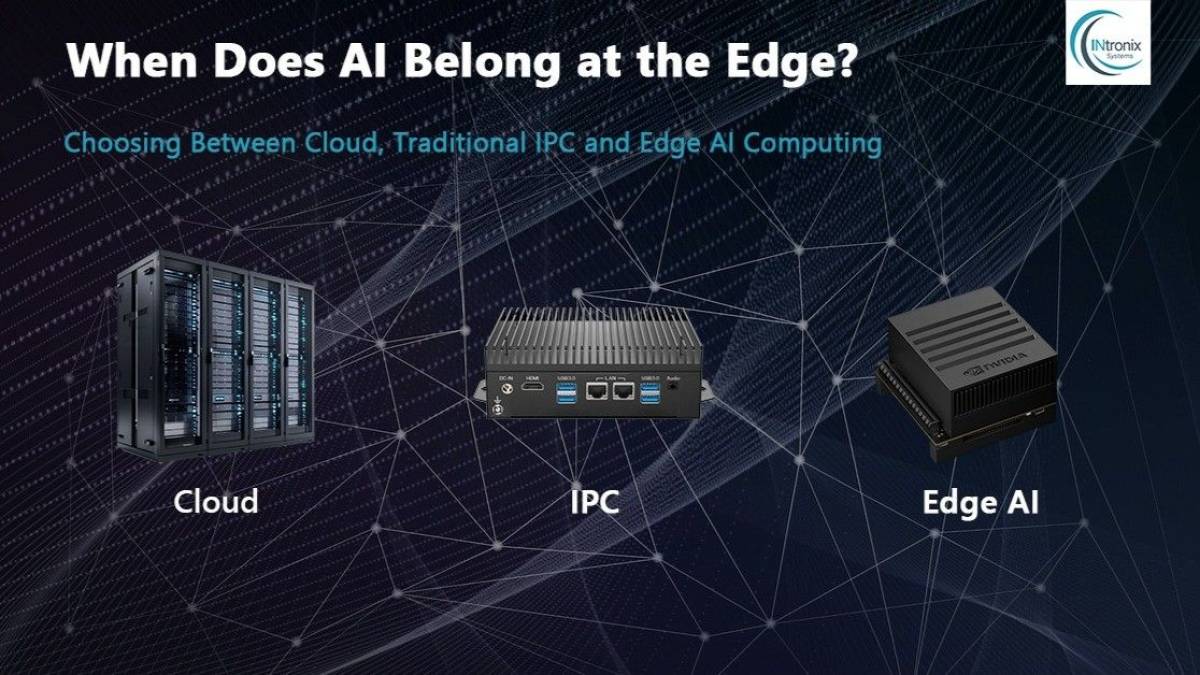
This differs from a purely Cloud-based approach:

  • Cloud: data is transferred to remote infrastructure for processing.
  • Edge: processing takes place locally or close to the equipment.
  • Edge AI: an artificial intelligence model performs inference at the Edge.

This distinction matters: Edge computing and Edge AI are not synonymous. An industrial PC can process data locally without running an AI model.

Cloud, industrial PC or Edge AI: three different approaches

Architecture Main processing location Particularly suited to
Cloud Remote infrastructure Centralisation, deferred processing, data consolidation
Traditional industrial PC Local HMI, SCADA, communication, data collection, business applications
Edge AI Local with AI processing AI vision, OCR, detection, classification, intelligent analysis


The objective is therefore not to determine which technology is the most advanced.

The real question is where processing should take place and how much computing capability the application actually requires.

When is a traditional industrial PC still enough?

The development of industrial AI does not make conventional industrial PCs obsolete.

For many applications, they remain entirely appropriate.

Automation and control

When a system mainly needs to run industrial software, communicate with equipment or provide supervision functions, a conventional computing platform may be sufficient.

Typical applications include:

  • HMI;

  • SCADA;

  • data acquisition;

  • industrial communication;

  • IIoT gateways;

  • MES terminals;

  • machine supervision.

Adding AI acceleration to these applications does not automatically provide a benefit.

Data collection and transmission

An industrial PC can also collect, filter, aggregate and transmit data without requiring an artificial intelligence model.

The need for local processing therefore does not automatically mean a need for Edge AI.

When does Edge AI become relevant?

Edge AI becomes particularly useful when data needs to be analysed locally and an artificial intelligence model is directly involved in the processing.

Several factors can justify this approach.

1. When latency matters

An industrial application may require a rapid response after data has been captured.

Consider a camera inspecting products on a production line.

The system may need to:

  1. acquire an image;

  2. analyse it;

  3. identify a feature or anomaly;

  4. immediately send the result to the system.

Systematically sending images to remote infrastructure adds a network communication step.

Local processing moves inference closer to the source of the data.

Typical applications

  • visual inspection;

  • object detection;

  • robot guidance;

  • automated sorting;

  • industrial OCR;

  • video analysis.

2. When data volumes become significant

Vision systems provide a good example.

One or more cameras can continuously generate large amounts of data.

Systematically transferring all this raw data to the Cloud can significantly increase bandwidth requirements.

Edge processing makes it possible to analyse data locally and, depending on the application, transmit only the information that is required: inspection results, detected events, metadata or selected images.

3. When network connectivity cannot be considered permanent

Not every industrial installation has continuous network connectivity.

A system installed in a vehicle, mobile equipment, remote infrastructure or certain outdoor sites may experience periods of limited connectivity.

When the function must continue to operate without permanent access to Cloud infrastructure, local processing becomes particularly important.

Edge AI can then perform inference directly on the local computing platform.

4. When some data needs to remain local

Production images, process-related information and inspection data may be sensitive.

Local processing can, depending on the system design, reduce the amount of raw data transmitted to external infrastructure.

This does not replace an appropriate cybersecurity strategy, but it makes it possible to reconsider which data actually needs to leave the machine or production site.

Edge AI and machine vision: a natural combination

Machine vision is one of the major applications for Edge computing.

AI can, for example, be used to:

  • detect an object;

  • identify an anomaly;

  • classify a component;

  • read characters;

  • analyse an image;

  • assist a robotic system.

Processing can be performed directly on a system located close to the cameras.

However, this does not mean that every machine vision system requires an Edge AI platform.

Requirements depend on the number of cameras, their resolution, acquisition rate, processing workload and AI model.

CPU, GPU or NPU: why hardware acceleration can matter

Not every AI workload requires the same computing resources.

Some inference workloads can run on a CPU. Other applications benefit from dedicated acceleration.

Depending on the platform, this may involve:

  • GPU;

  • NPU;

  • dedicated AI accelerator.

The appropriate solution depends on the AI model, number of data streams, required performance, power consumption and thermal constraints.

TOPS or raw GPU performance should therefore never be the only selection criterion.

For a deeper look at computing platform selection, read our guide Choosing the Right CPU for an Industrial PC, Panel PC or Fanless System.

Fanless Edge AI: thermal design becomes critical

Deploying AI computing close to a machine introduces another important consideration: heat dissipation.

GPUs, CPUs and AI accelerators can generate more heat than platforms designed for lighter industrial workloads.

In a fanless system, this heat must be dissipated without forced-air cooling.

Platform selection must therefore consider several factors together:

  • computing workload;

  • power consumption;

  • ambient temperature;

  • enclosure design;

  • thermal dissipation;

  • installation constraints.

An extremely powerful platform is not necessarily the right platform if it becomes difficult to integrate thermally.

How do you know whether your application really needs Edge AI?

Before selecting hardware, answer these questions.

  • Does the application actually use an AI model? If not, a traditional industrial PC may be sufficient.
  • Does the system need to make a rapid decision from incoming data? If yes, moving processing closer to the data source may be relevant.
  • Does the system process large volumes of images or data? Local processing can reduce the amount of data that needs to travel across the network.
  • Must the application continue to operate without permanent connectivity? Local processing reduces dependence on remote infrastructure.
  • Does the model require specific acceleration? CPU, GPU, NPU or dedicated accelerators should be evaluated according to the actual workload.
  • How many cameras or data streams must be processed simultaneously? This can significantly affect computing, memory and bandwidth requirements.

Decision table: traditional industrial PC or Edge AI?

Requirement Traditional industrial PC Edge AI
HMI / SCADA ✓ Not required by default
Industrial communication ✓ Not required by default
Data collection ✓ Depends on analysis
MES ✓ Application-dependent
Conventional machine vision Depends on processing Depends on processing
AI object detection Possible depending on workload ✓
AI-based OCR Possible depending on workload ✓
AI visual inspection Depends on complexity ✓
AI video analytics Depends on workload ✓
Local multi-camera AI inference Configuration-dependent ✓


This table is intentionally indicative. The boundary depends on the software, AI model, data throughput and required performance.

Edge AI and Cloud are not necessarily competing approaches

Choosing Edge AI does not necessarily mean eliminating the Cloud.

They can perform different functions within the same system.

An Edge platform can perform inference locally and transmit only results or selected data to central infrastructure.

Cloud infrastructure can then perform other functions such as centralisation, global analysis, data management or application-specific services.

The key decision is therefore which processing needs to happen locally and which processing can be performed remotely.

Do not oversize intelligence at the Edge

Edge AI opens new possibilities for machine vision, robotics and industrial analytics.

But deploying an AI platform where a conventional industrial PC would be sufficient can unnecessarily increase cost, power consumption, heat dissipation and integration complexity.

Start with the application:

  • What data is being generated?
  • How quickly must it be analysed?
  • Is an AI model actually required?
  • How much data needs to leave the machine?
  • Must the system operate independently from the network?

Only then should the hardware platform be selected.

INTRONIX Systems offers industrial computing platforms ranging from traditional Fanless PCs to systems capable of Edge processing and AI acceleration, allowing computing resources to be matched to the actual requirements of the application.